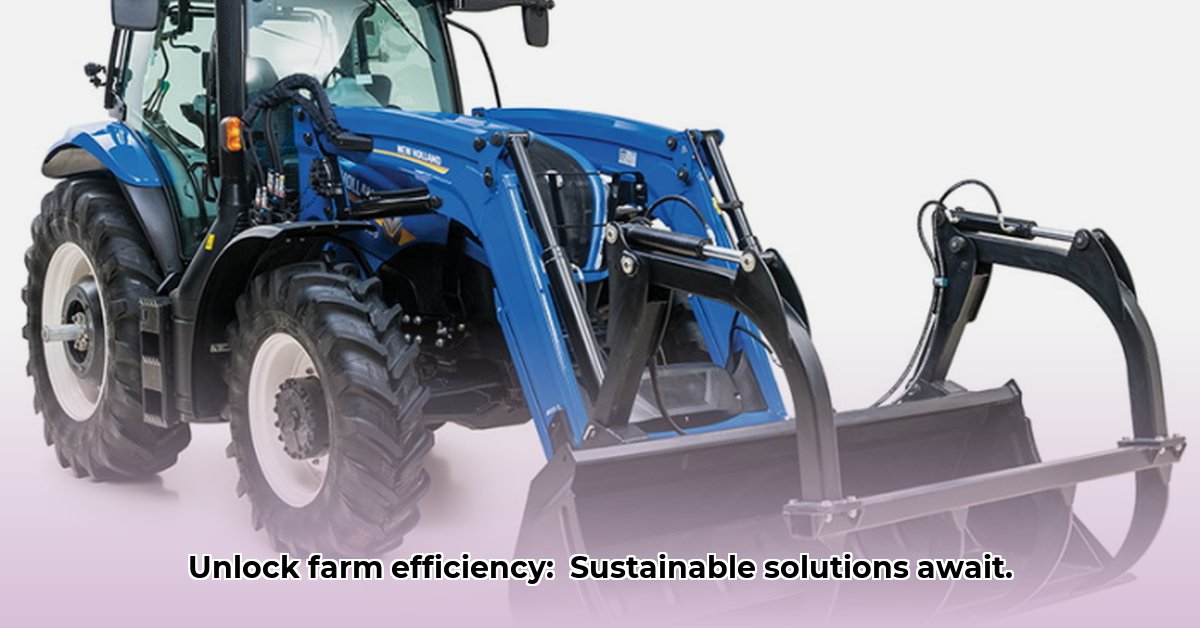
New Holland Tractor with Loader: Your Guide to Sustainable Farming
A New Holland tractor equipped with a front-end loader offers a significant advantage in modern farming, enhancing operational efficiency while minimizing environmental impact. This guide provides actionable steps for maximizing both productivity and sustainability. For detailed diagrams, check out the parts diagrams.
Choosing the Perfect New Holland Tractor and Loader Combination
Selecting a New Holland tractor and loader demands careful consideration of your farm's specific needs. Small farms may find a smaller, more maneuverable loader sufficient for tasks like feeding livestock or handling modest manure quantities. Conversely, larger farms requiring extensive material handling (e.g., large-scale hay baling) will benefit from a larger loader with increased lifting capacity and reach.
Consider your typical workload. What are your primary tasks? Manure management? Hay baling? Fertilizer application? This assessment will dictate the required lifting capacity and reach. Compatibility with existing machinery is crucial; ensure seamless integration of the loader's hydraulic system with your tractor.
Working Smarter, Not Harder: Sustainable Loader Operations
Efficient loader operation is paramount for minimizing environmental impact and maximizing cost-effectiveness. Precise movements are key. Avoiding spillage during fertilizer application, for example, drastically reduces waste and prevents harmful runoff. Using the right attachment for the job (bale grapple for hay, standard bucket for manure) also enhances efficiency.
How can precise loader operation help a farmer save money and reduce environmental impact? Precise movements minimize spills, reducing fertilizer waste and preventing water contamination, thus saving money and protecting the environment.
Fuel efficiency is crucial. Proper maintenance and operating the loader within its capabilities are essential. Consider integrating GPS-guided systems for improved accuracy in fertilizer or material spreading, enabling variable-rate application and reducing resource waste.
Precision Agriculture: Taking It to the Next Level
Integrating your New Holland loader into a precision agriculture system significantly enhances sustainability. Sensors on implements provide real-time data on soil conditions, facilitating variable-rate fertilizer application. This minimizes waste and optimizes yield. "The application of precision agriculture technologies, such as variable-rate fertilizer application, can lead to significant improvements in resource use efficiency and environmental protection." - Dr. Emily Carter, Professor of Agricultural Engineering, University of California, Davis.
Keeping Your Loader in Top Shape: Maintenance for Longevity and Sustainability
Regular maintenance is essential for maximizing loader lifespan and minimizing environmental impact. Adhere to New Holland's maintenance schedule. Regularly inspect hydraulic lines and fittings to prevent leaks, a primary source of wasted resources and increased costs. Proper lubrication minimizes friction and wear, preventing small problems from escalating into costly repairs.
Calculating Your Return on Investment (ROI): More Than Just Numbers
The initial investment in a New Holland loader is substantial, but the long-term benefits justify the cost. Calculate ROI by considering the initial cost, fuel expenses, labor savings, improved efficiency, reduced waste, enhanced yields, and any potential government subsidies or tax incentives for sustainable practices. This comprehensive analysis will demonstrate overall value and long-term profitability.
What are some key factors to consider when calculating the ROI of a New Holland loader? Initial cost, fuel consumption, labor savings, increased efficiency, reduced waste, improved yields, and potential government incentives.
Comparing New Holland Loader Models: A Hypothetical Example
The table below outlines hypothetical New Holland loader models. Actual specifications may differ.
| Model | Lift Capacity (lbs) | Max. Reach (ft) | Fuel Efficiency (gal/hr) | Implement Compatibility | Notes |
|---|---|---|---|---|---|
| L120 | 3000 | 10 | 3.5 | Standard Bucket, Bale Grapple | Ideal for smaller farms or lighter-duty tasks. |
| L180 | 4500 | 12 | 4.0 | Standard Bucket, Bale Grapple, Fertilizer Spreader | Versatile option for medium-sized operations. |
| L240 | 6000 | 14 | 5.0 | Standard Bucket, Bale Grapple, Fertilizer Spreader, Pallet Forks | Suitable for large-scale farms and heavy lifting. |
How to Reduce Fuel Consumption Using New Holland Loaders in Sustainable Farming
Key Takeaways:
- Optimized loader operations significantly reduce fuel consumption.
- Selecting the appropriate loader model minimizes fuel waste.
- Routine maintenance extends loader lifespan, reducing long-term fuel costs.
- Integrating precision agriculture technologies improves efficiency and reduces fuel use.
Sustainable farming requires maximizing resource efficiency. Fuel costs are a significant expense. A New Holland loader's power and versatility are invaluable, but minimizing fuel consumption is essential.
Choosing the Right New Holland Loader
Selecting the appropriate loader model is the first step. Oversized loaders waste fuel; undersized loaders strain the tractor. Match loader capacity to your farm's needs, avoiding both underpowering and overspending on unnecessary capacity.
Optimize Loader Operations
Efficient operation directly translates to fuel savings.
- Smooth Movements: Avoid jerky movements. Gentle acceleration and deceleration conserve fuel.
- Correct Loading Techniques: Accurate loading minimizes wasted effort.
- Avoid Overloading: Overloading strains the tractor and loader, increasing fuel consumption.
- Maintain Correct Tire Pressure: Under-inflation increases rolling resistance, wasting fuel.
Integrating Precision Agriculture
Precision agriculture technologies revolutionize fuel efficiency.
- GPS Guidance: Automated steering minimizes overlap and over-application, saving fuel and resources.
- Yield Mapping: Identify areas requiring more or less material, optimizing application rates.
- Sensors and Telematics: Monitor fuel use in real-time, identifying and correcting inefficiencies.
Routine Maintenance: A Cornerstone of Fuel Efficiency
Regular maintenance is crucial for long-term fuel efficiency and equipment longevity.
- Hydraulic System Checks: Regular inspection prevents fuel-wasting leaks.
- Engine Maintenance: Proper engine tune-ups minimize fuel consumption.
- Lubrication: Regular lubrication reduces friction, extending lifespan and lowering fuel costs over time.
Calculating Your Return on Investment (ROI)
Investing in fuel-efficient practices leads to substantial financial savings.
- Track Fuel Consumption: Keep detailed records of fuel use.
- Calculate Savings: Compare fuel costs before and after implementing the strategies above.
- Consider Loader Lifespan: A longer lifespan directly improves ROI.
By implementing these strategies, you can significantly reduce fuel costs while adhering to sustainable farming practices. Remember, responsible resource management is crucial for both environmental protection and long-term economic success.